Article
The Audio Heretick's Progress
Or why HiFi is an illusion and successful HiFi systems are illusion engines. A position paper by Thorsten Loesch.
Audio SciencePsychoacousticsTL;DR
Measurements and listening agree only at the extremes. Better numbers can sound worse, worse numbers can sound better. And there is nothing fixed to be faithful to: studio, microphone, master and loudspeaker each change the signal. High fidelity is not difficult. It is impossible.
What a good HiFi system delivers is a credible illusion of listening to music. It is an illusion engine, and the people who build good ones are closer to magicians than to engineers.
The figures of merit (FOMs) the industry sells by began as advertising with Leak’s 0.1 % “Point One”, and were never checked against what listeners hear (Toole, Olive et al. aside). That is cargo cult science: the form is perfect, but the planes don’t land. Audio needs correction against reality; its lobbies will fight it.
The positions that follow are heretical to anyone and everyone in audio. This paper follows their progress, one stage at a time.
One image runs through all of them. In 1974 Richard Feynman described the cargo cults of the South Seas: islanders who built runways, lit fires along them and put a man in a wooden hut with wooden headphones, waiting for the aeroplanes to return. The form was perfect. But no aeroplanes landed. Much of audio is like that. We have built the runways. The planes don’t land.
Stage 1: Measurements and listening do not agree
Science can only tell us about the nature of reality. It can tell us what people hear, how and why, and the scientific method can be used to determine what people like.
Science cannot devise the technology. That is engineering, and so is standardising technology. But engineering should be science and evidence based.
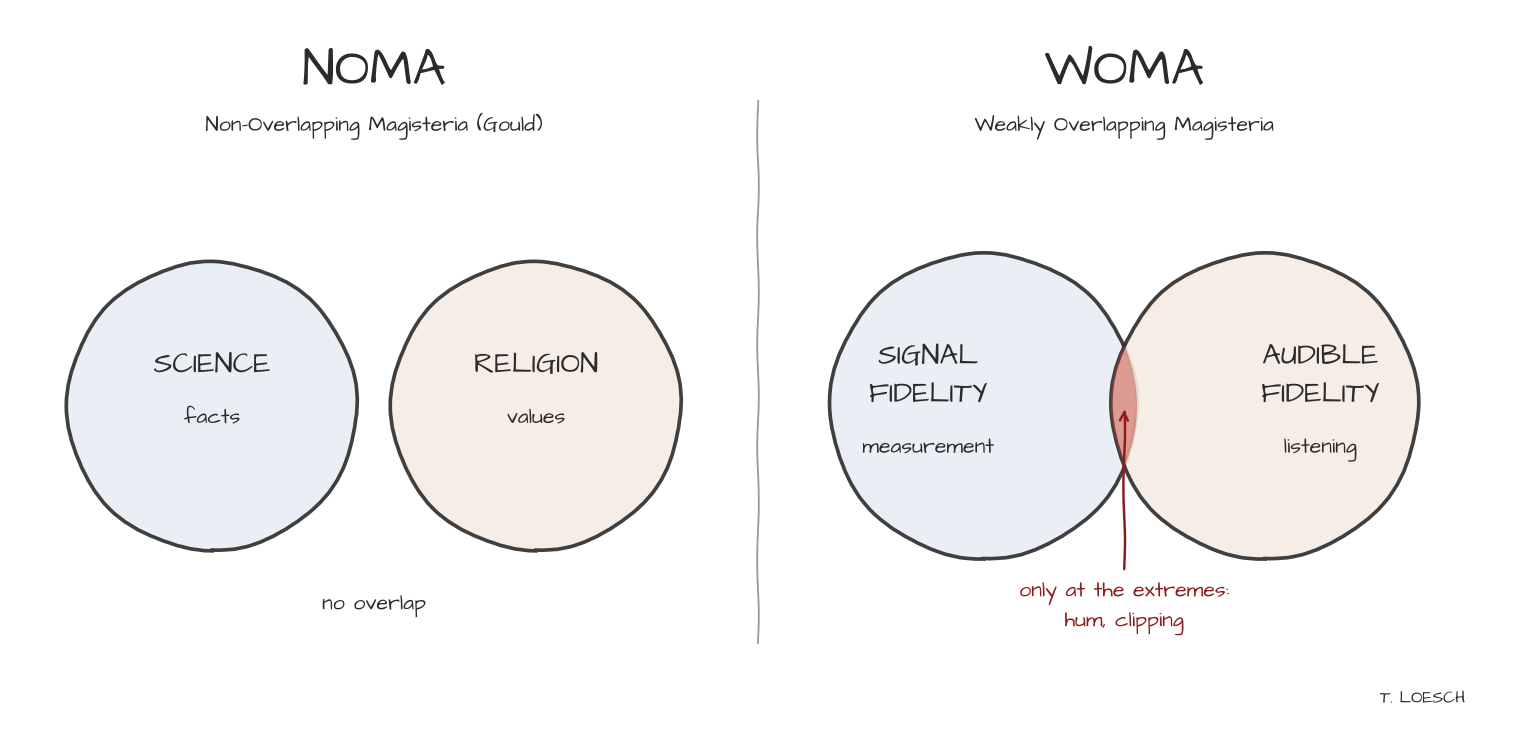
With that in mind: measurements of signal fidelity (often called objectivism) and subjective evaluation of audible fidelity (often called subjectivism) are what I call WOMA, Weakly Overlapping Magisteria. The term comes from Stephen Jay Gould’s NOMA, non-overlapping magisteria: his view that science and religion represent different areas of inquiry, fact versus values, so there is a difference between the “nets” over which they hold “a legitimate magisterium, or domain of teaching authority”, and the two domains do not overlap.
If we use an Audio Precision AP2 to measure signal fidelity, that is one “net”, over which it and related methods hold a legitimate magisterium. When we run blind preference listening tests and ask for audible fidelity impairment scores, that is another net, over which this method and related ones hold their own legitimate magisterium. (Not ABX: more on that in Stage 5.)
In an ideal world we would by now have seen an effort to reconcile the two magisteria, from which a way of expressing subjective sound in numbers would naturally emerge. The only real work of this kind that has been done systematically, and taken up, is on loudspeaker and headphone frequency response, by Toole, Olive and Welti. Others offered metrics of the same kind for distortion: the R.M.A. (1937), Olson, D.E.L. Shorter of the BBC and, more recently, Geddes and Lee (2003). Unlike the work of Toole and his colleagues, these were completely ignored (see the appendix, Failed attempts).
So in the real world, improving signal fidelity does not reliably improve audible fidelity, nor does worse signal fidelity reliably make audible fidelity worse.
There are limits, of course. A sound system with obnoxious hum and severe clipping clearly shows severe audible fidelity impairment and severe signal fidelity impairment. The two magisteria overlap at these extremes, and only weakly in between.
The FOM
Signal fidelity is often expressed as a single figure of merit (FOM): THD+N, SINAD, or nn ps of jitter. It tries to express complex, multidimensional phenomenæ as one easily approachable number for comparison, with the implication, or the outright claim, that a better number means better fidelity.
Even for pure signal fidelity this approach is often questionable, and sometimes inconstructive. Extended to audible fidelity, the FOM becomes not merely inconstructive but deconstructive: divorced from any relation to audibility except, as WOMA implies, under the most extreme conditions, which one would hope are commonly avoided.
A technical feature that can cause audible fidelity impairment while staying invisible to the usual FOMs, unless the design addresses it, I call a potential trouble source (PTS).
We have WOMA because the planes don’t land: decades of ever better FOMs, and the sound has not reliably followed them.
Stage 2: What can be heard
Humans are very sensitive to things that are not natural. That is a critical realisation. Whether an alteration is heard, and whether it is liked, depends on its nature, not on its size. That is why I class fidelity impairments in four groups, not two:
| Impairment class | Determined by | What listeners report |
|---|---|---|
| Signal fidelity impairment | Instrumentation | (not a listening category) |
| Audible, preferred | Listening | The alteration is audible and is preferred to the unaltered signal |
| Audible, neutral | Listening | The alteration is audible, but neither preferred nor disliked: rated the same as the unaltered signal |
| Audible, objectionable | Listening | The alteration is audible and disliked: the original is preferred |
Only the first class is visible to the instruments. The other three are visible only to listeners.
Stage 3: Fidelity to what?
Consider the chain from performance to living room:
- A studio session is not a live performance.
- A microphone is not an artificial ear. The signal leaving the microphone is not what a human in the same location would hear.
- The signal leaving the microphone is not what the released recording contains.
- The recording is replayed over a loudspeaker (set) that does not recreate the sound field that was present when the microphone picked up the sound.
In this context, what is the meaning of “fidelity”? Fidelity to what? To the microphone signal? To the recording? To the original sonic event?
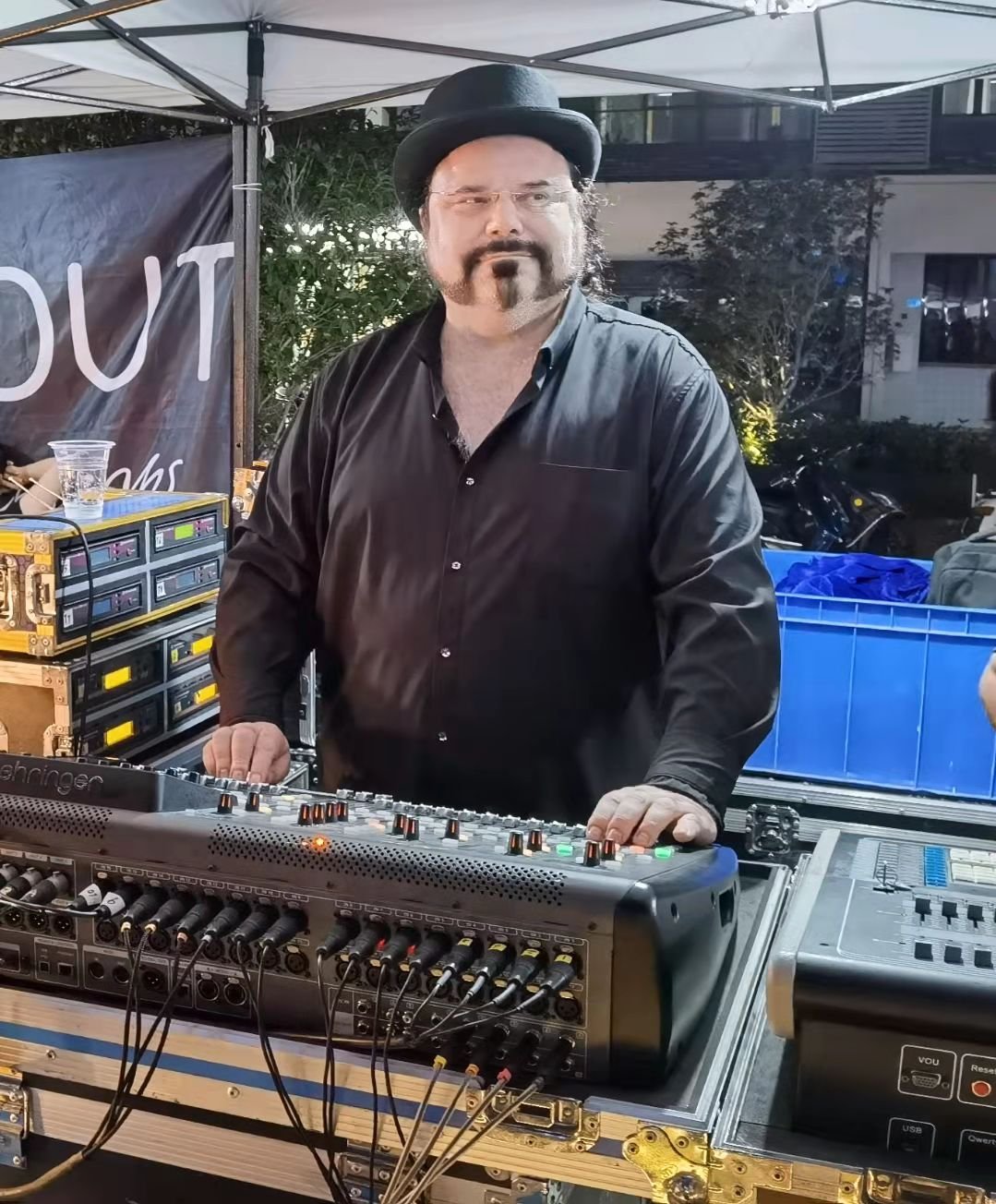
There is worse to come.
Recordings are mastered and judged for fidelity … using loudspeakers, which are judged for fidelity with recordings that are made with microphones and are mastered and judged with other loudspeakers. These recordings are recorded with microphones, which are judged for fidelity … (return to the first ellipsis and continue reading).
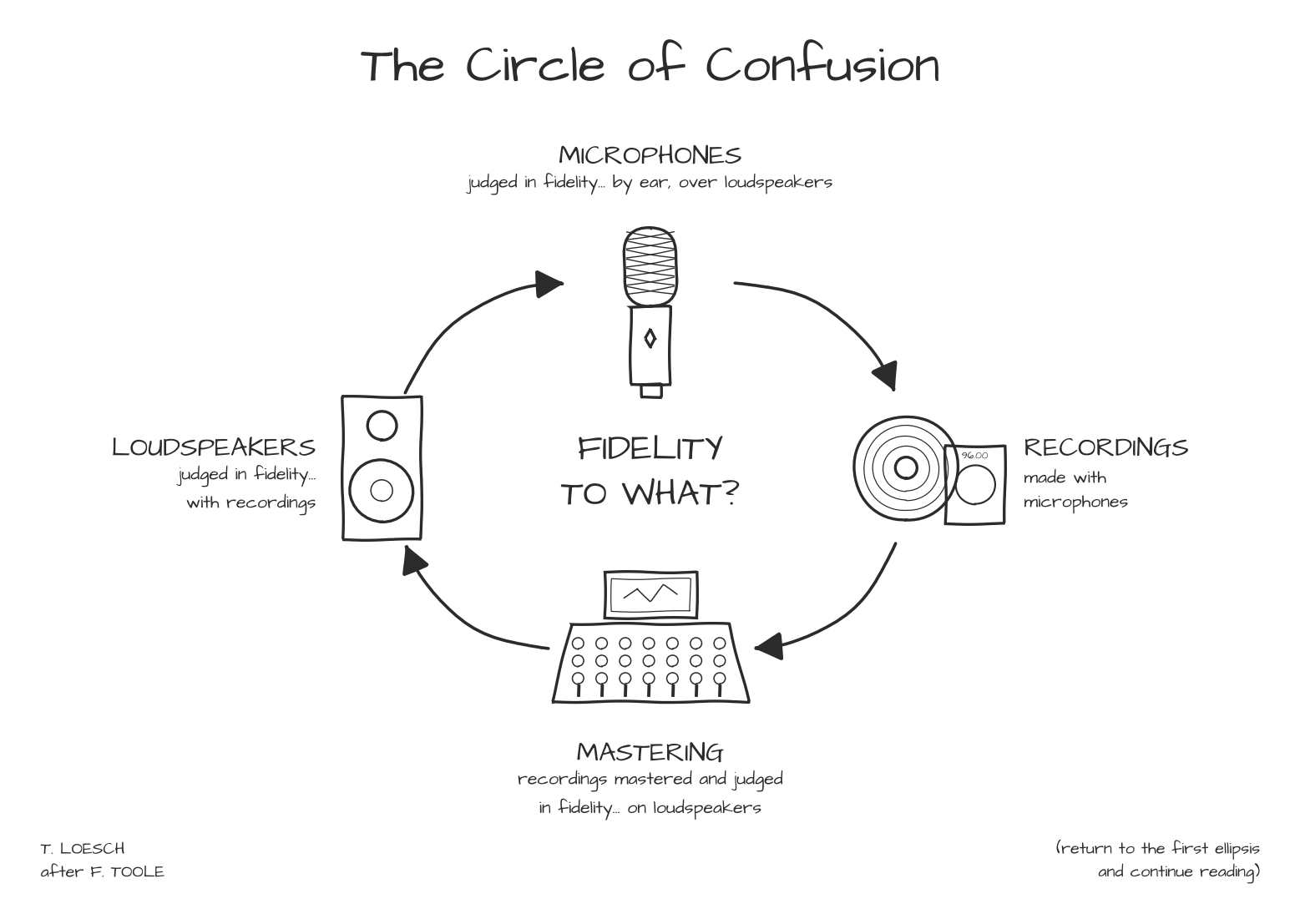
Floyd Toole calls this the “circle of confusion” (in Sound Reproduction). My wording is a little different and drives in a slightly different direction. Toole’s way out is to make the loudspeakers on both sides of the circle follow the same science-based criteria. Mine is to ask whether fidelity is the right goal at all.
J. Gordon Holt, the founder of Stereophile, took on why the experts cannot agree in “Why Hi-Fi Experts Disagree”, first published in February 1963. His answer: listeners differ in hearing, in training and in what they listen for, and for the reproducing system it is fidelity to the recording that counts, not fidelity to the original sound. For easy consumption, Head-Fi legend Zeos presents it on video. For those who like to read, Stereophile has the expanded three-page version.
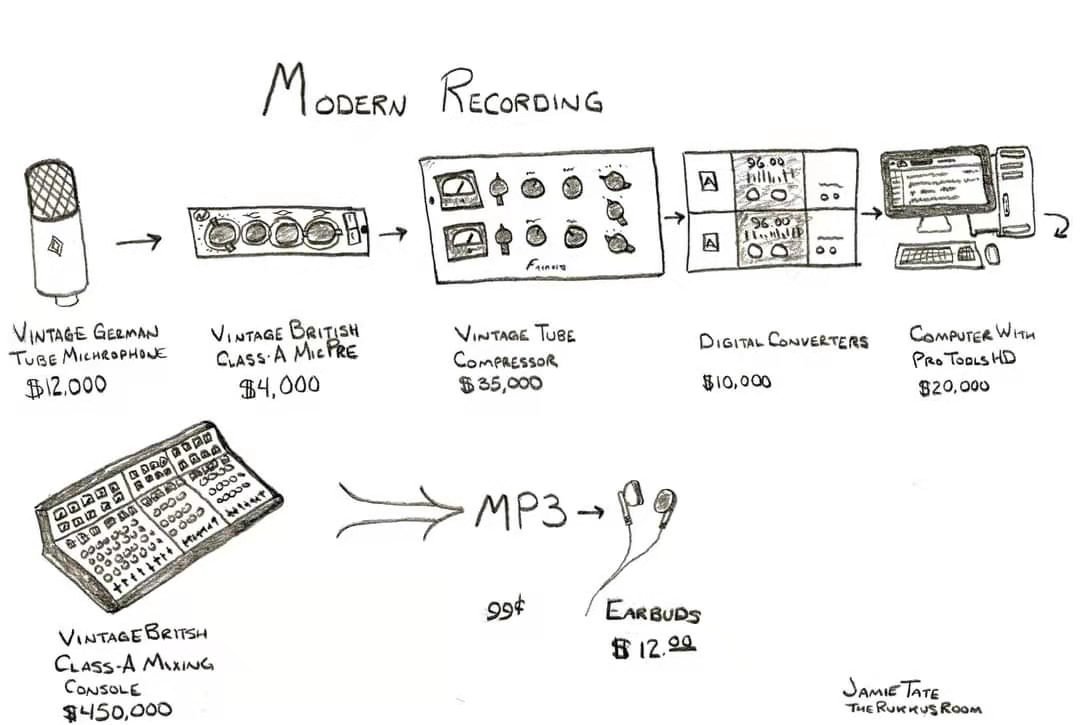
Stage 4: High fidelity is impossible
My conclusion? High fidelity is an illusion. High fidelity is impossible. Not even Holt’s fidelity to the recording survives the circle: the recording was itself judged on loudspeakers, which were judged on recordings.
What is possible is a credible illusion of listening to music.
Ergo a successful HiFi or HeadFi system is an illusion engine, not a high fidelity reproduction system.
Roy Doty drew one. His listener sits cross-legged in a box of loudspeakers, walled in by valves, transformers, meters, tape machines and test gear, eyes closed, perfectly content. All that machinery exists for one purpose: to make him forget it is there.
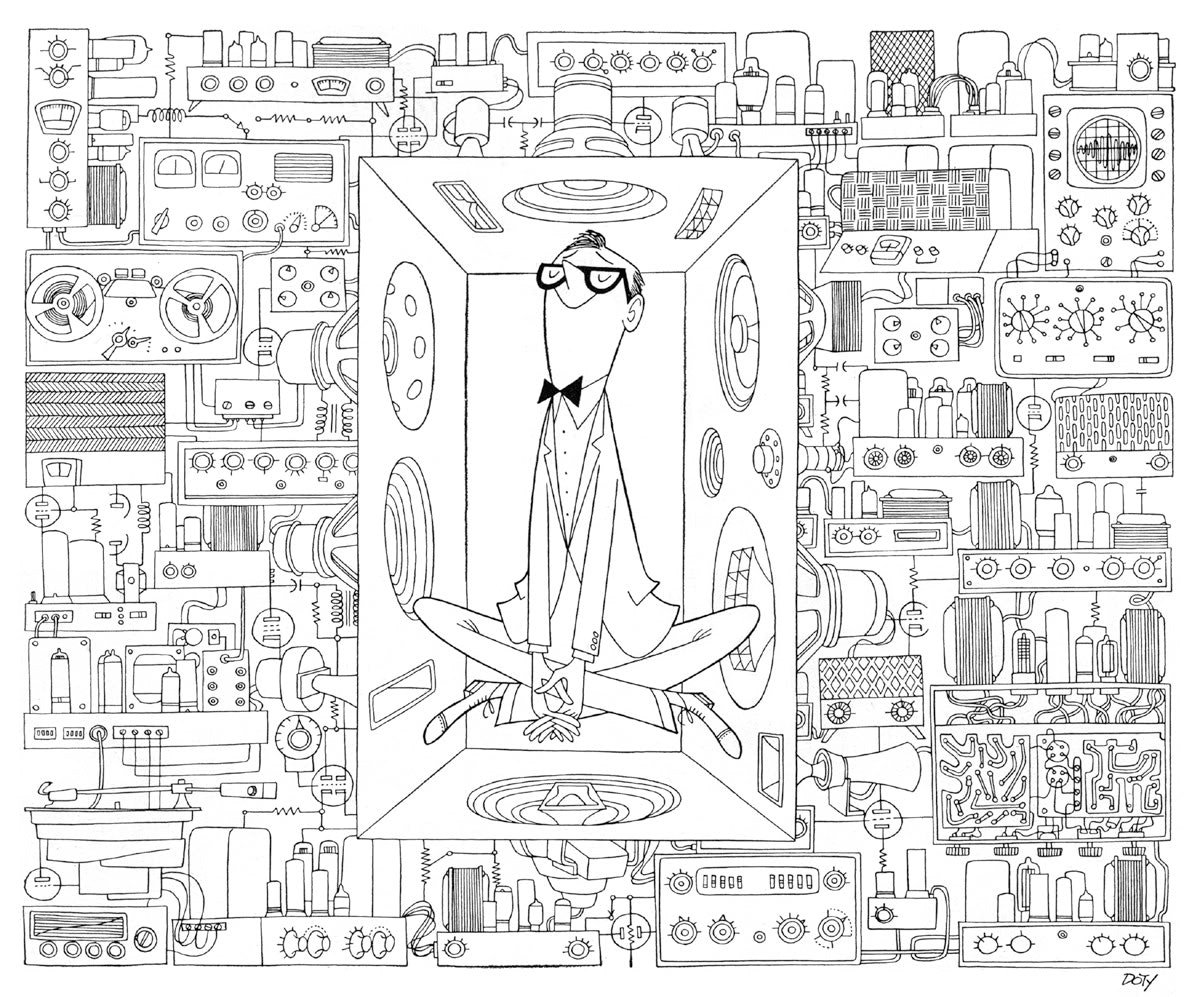
An illusion is often also called magic (with a c, to separate stage illusions from “true” magik). So we are dealing less with a classic engineering challenge and more with magic. A successful audio or sound engineer is more of a magician and less of a traditional engineer. His tools are the audible, preferred alterations of Stage 2. His enemy is the audible, objectionable kind.
This is not a new position for me. In 1999 I already called true high fidelity inherently impossible, though then only for digital audio (Thermionic Valve Analogue Stages for Digital Audio).
Nor is the ear as the final judge. My articles on theory have always worked from it: the harmonic spectrum the ear itself produces and masks (Some Thoughts about Single-Ended Valve Amplifiers), which distortion matters in a DAC output stage and which does not (Why DACs Produce Ultrasonic Output), a digital filter shaped around the ear’s own ringing (Why All Digital Filters Are Wrong), and a loudspeaker judged by the sound it makes in a real room rather than by a flat on-axis curve (Why Dipole Speakers).
The other side of the coin
In HiFi and High End we also see equipment that performs poorly on the classic signal fidelity metrics (meaningless as these are) and is priced at extreme levels. Often the engineering, if the word even applies, is pegged to “we listen only, no measurements”: an aggressive marketing and design creed, and the justification for extremely expensive parts and exotic materials, followed by prices that would make the descendants of the Light Brigade blush.*
This is a different angle, and not one this paper really engages with. Such systems may well produce a better illusion than conventional ones, because that is what they are designed for: by ear, without measurements, over many thousands of hours of “just listening”. In my experience, though, this often comes at a cost: in basic operational performance, in the ability to play all genres of music equally well (not just those the designer favours), and even in basics such as adequately low noise.
Little about this side of audio has logic or method, apart from their consistent absence and the rejection of “measurements” ex cathedra. Unlike cargo cult science, it does not pretend to be scientific. It is unashamed witch-doctoring, selling “Doctor Good” and snake oil. It is the flip side of the same underlying problem.
In the end, what people spend their money on and what they enjoy is their own choice. As J. Gordon Holt put it, “there is no sense in anybody’s choosing a music system whose sound he doesn’t like”. At best we can play Paracelsus**: glean the small nuggets of truth from a large body of superstition, folk tale and witch-doctoring. That we leave for another article.
* The Charge of the Light Brigade: at Balaclava in 1854, during the Crimean War, British light cavalry rode straight down a valley at the Russian guns, because of a garbled order. Tennyson’s poem made it famous. To the British it is the byword for magnificent, suicidal recklessness. Its descendants should not blush easily, yet HiFi priced at six figures in pounds sterling manages it.
** Paracelsus (1493–1541), Swiss physician and alchemist. He collected remedies from witch-doctors, herbalists, barber-surgeons and old wives, then asked the critical question: does it actually work, and at what dose? His answer, “the dose makes the poison”, made him the father of toxicology and a forerunner of evidence-based medicine: observation and test over received authority. That one question turned folklore into science.
Stage 5: The orthodoxy, or audio cargo cult science
The worst thing is that many who appear scientific in audio are actually passive, biased testers following lobby rules. They practise cargo cult science, as defined by noted Latin percussionist Richard Phillips Feynman. It is HIGHLY RECOMMENDED to read his thoughts: Cargo Cult Science, his 1974 Caltech commencement address.
A word on terms. “The lobby” is my shorthand for the interested parties who wish to preserve the current cargo cult, because it benefits them financially.
How it started
Most audio measurements were standardised because people started using them in advertising.
The old shyster Harold J. Leak probably started this with his “Point One” products. His amplifiers and preamplifiers of the Point One range were really no different from competent products from his competition. The competition rated their products at so many watts at 3, 5 or 10 % harmonic distortion. Leak changed the game by rating his power at 0.1 % and advertising 0.1 % distortion as a feature. The audio FOM was born.
Easy sell. Ask the customer: “Do you want to buy this amplifier with 0.1 % distortion, or that one with 3 % distortion?” What the customer was not told: under identical conditions, the “3 % distortion” amplifier would probably also have 0.1 % distortion.
The reason: Leak circuits of the era are the same industry-standard circuits as everyone else’s, based on the valve makers’ recommendations and publications. They show no variations that would give them different distortion characteristics from the same circuit built by another manufacturer, with the same valves and identical or equivalent passive parts. Leak did not change the engineering. He merely moved the goalposts.
Then other manufacturers got in on the low-distortion advertising, and suddenly someone advertised 0.07 %. Everyone measured differently. Standardised instrumentation did not exist; even standard measurement protocols did not exist. Some told outright lies.
So the same kind of consumer-protection crusaders who would later sell the ABX test in a box forced the industry to self-regulate, and got the Federal Trade Commission and other legal bodies involved. In Germany the same role fell to DIN 45500 (1966), which set the minimum requirements a product had to meet to be sold as “Hi-Fi”.
Regulated, but never checked
So test methods were standardised and advertising was regulated. On the whole, this regulation was sensible.
The problem: the measurements used to advertise equipment had never been scientifically correlated with audible fidelity impairment or listening preferences. They were decided at the green table, and never corrected by collision with reality, the latter correction being the HALLMARK of true science. The runways were built. The planes never landed.
Between the R.M.A. (1937) and Olson (1940), it had been established well before its use in advertising that unweighted total harmonic distortion, as a measure of audible distortion, is utterly invalid and meaningless. Shorter (1950) and Crowhurst (1957) confirmed it. THD, like every single-number FOM, measures only the first of the four classes in Stage 2, signal fidelity impairment. It cannot tell you which of the other three a distortion falls into. Even where both agree a system is badly broken, THD cannot tell you how audible the damage is: Voishvillo’s listeners found 22.6 % THD from clipping less objectionable than 2.9 % from crossover distortion. Over the decades we have seen many attempts to reform this (see the appendix, Failed attempts). All of them failed against the “united front” of the lobby and the self-proclaimed “objectivists” and “audio scientists”.
Yet even in 2026, when the instrumentation and software for a reliable, audibility-weighted distortion metric (including non-harmonic and aharmonic components) are inexpensive and widely available, and the science is well established and accessible, THD+N still prevails, along with the novelty of restating THD+N as “SINAD” to seem new and scientific: the same FOM under a new name.
That is not science. That is a cargo cult, and in Feynman’s terms, THE PLANES DON’T LAND! So we know it for sure. What is worse: where Feynman asks for such things to be looked into, this has been looked into, shown to be pseudoscience, and is still practised. It shares that trait with ABX audio testing.
A word on ABX
ABX as a principle is sound. It tests whether a listener can tell A from B, and it came from Bell Labs in 1950. For design purposes it is pointless, because it generates zero actionable information. As usually run, a null result is too weak statistically to mean anything (see the appendix on ABX). A positive result says only that a difference exists, not which version is preferred, or what to do next. In the terms of Stage 2, it cannot tell an audible, preferred alteration from an audible, objectionable one.
The latter-day ABX apostles are another matter. They did not invent the test. They produced the “ABX test in a box”: the ABX Comparator, sold from 1977 at 495 USD (about 2,700 USD in 2026 money) against a bill of materials of about 75 USD, and promoted to consumers together with the test. In their hands it became the test that made everything sound the same.
The Status Quo
Thus ALL of audio “science” is, at its core, cargo cult science. It is not evaluated against reality. It is not self-correcting. It is just self-perpetuating.
Actually, not ALL, just a heck of a lot of it. The work of Toole, Olive and Welti on loudspeakers and headphones is checked against listeners.
So what is needed is a radical re-evaluation of audio science: a correction against reality that turns the audio science cargo cult into true science, which corrects itself. But the very lobbies that created this cargo cult sustain it, and resist adjustment and correction.
Stage 6: A Clarion for Universal Reformation in Audio Science
It is a tragedy, and a personal annoyance, that a paper like this still needs writing in 2026.
Nothing here is new. Auditory masking has been in the peer-reviewed literature for over half a century, the circle of confusion since at least 1990. Yet here we are, still going round the same loop of specification chasing, pseudoscientific arguments and guru worship.
The mainstream audio industry has chosen to ignore its own scientific history, and has built a very profitable church on a lobby-determined pseudoscience instead. That is cargo cult behaviour: the form of science, without its habit of checking itself against reality. We measure what is cheap and easy to measure on a static bench, print it in a glossy brochure, and pretend it correlates with enjoyment.
Tweaking a measurement protocol, swapping a boutique capacitor or patching up ABX will not break this cycle. It needs a complete overhaul, in the classic three parts of a universal reformation: the individual, the physical world and the institutions, all three rebuilt on evidence.
I. The Listener
Reformation begins at home, with the listener. For decades the commercial audio complex has treated the human ear as a brainless, linear measurement microphone. It isn’t. It is bound by masking thresholds and cognitive pattern matching, and any science worth the name starts there.
The listener needs weaning off the irrelevant decimal places of FOMs, and judging a sound system for what it is: a psychoacoustic illusion engine. The way forward is not better numbers but a better illusion, understood as one and enjoyed as one, the way we enjoy David Blaine or David Copperfield. A credible illusion beats an Audio Precision graph that tells us nothing about how we hear music.
II. The Hardware
From the listener, the reformation moves out to the physical world: the listening room, the copper, the silicon and the moving-coil transducer. Hardware should stop being tuned to static bench benchmarks that have nothing to do with music.
Good engineering works with physics, not against it, and builds systems that work reliably within it.
What good is a loudspeaker that measures perfectly flat on-axis in an anechoic chamber (or with pseudo-anechoic methods), but has poor directivity, and so produces a severely unbalanced sound field in the kind of room most people put it in? Toole and Olive showed long ago how to avoid this, yet such loudspeakers are still made and sold. What good is an amplifier with low measured THD at full power, but marked high-order crossover distortion at normal listening levels, and too little low-order harmonic content to mask it?
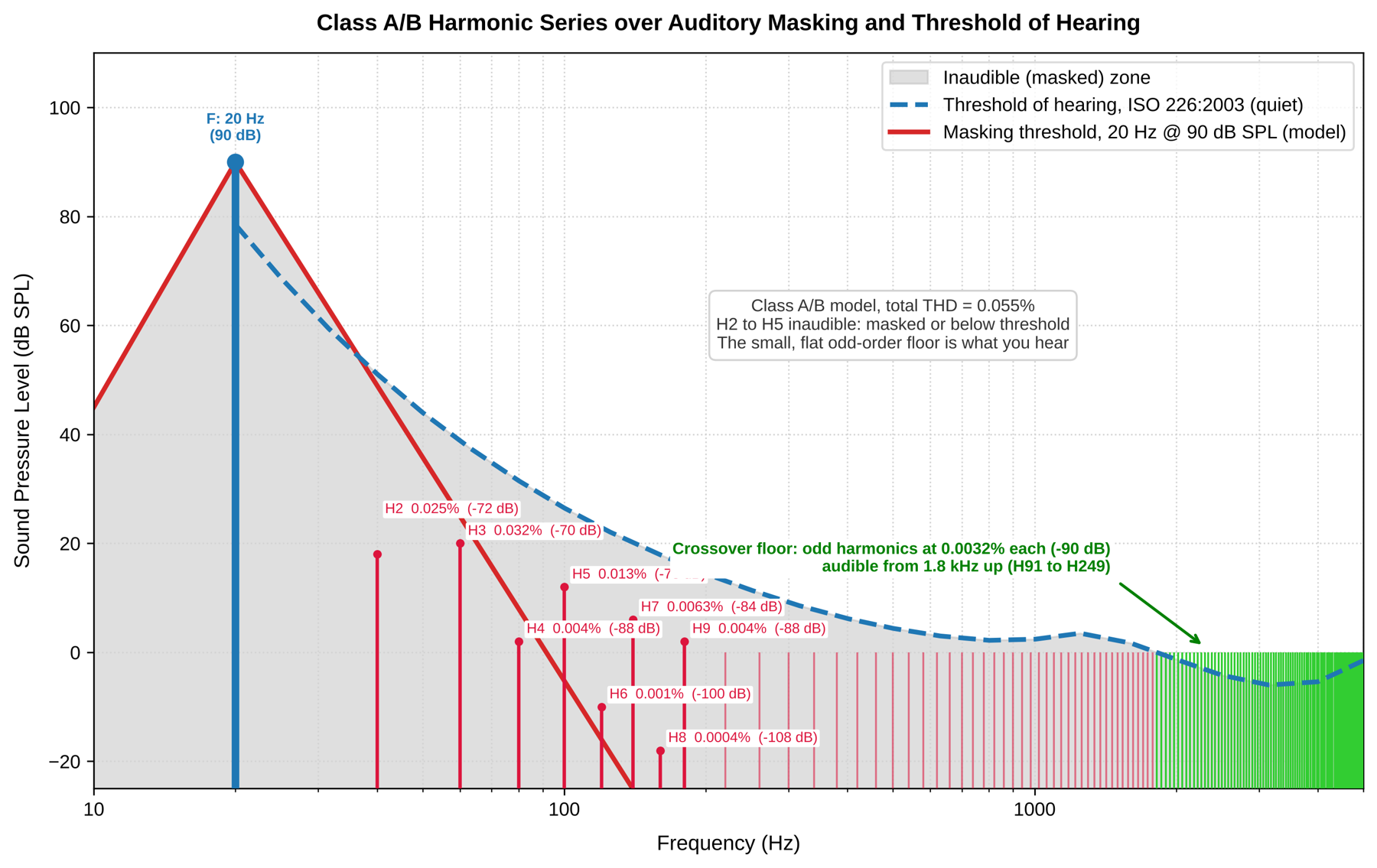
This is not a contrived case. An optimally biased, “blameless” class AB amplifier of the generic 100 W type (D. Self’s designs, for example) has crossover distortion of around 0.003 % (−90 dB) at 1 W. Into generic loudspeakers of 87 dB/W/m, at normal listening levels, the distortion products sit at around −3 dB SPL: right at the threshold of hearing in the 2 to 5 kHz region, where the ear is most sensitive, and so potentially audible. The graph uses the same −90 dB floor. To reduce the crossover distortion at normal listening levels, the amplifier would have to be overbiased significantly, which would increase its THD. That is precisely the trade this paper is about: measured against audible.
The FOM is excellent. The form is perfect and looks scientific. But the crossover distortion is potentially audible and objectionable: Stage 2’s fourth class, hidden behind an excellent FOM for the first. The planes don’t land. The job is to master electrical and acoustic behaviour, so the hardware delivers a credible illusion rather than a collection of impressive bench results.
III. The Institutions
Finally, the reformation must rectify the institutions: the corporate lobbies, the measurement dogmas, and the media personality cults that sell expensive certainty to the faithful. An orthodoxy that treats the listener as a passive consumer of abstract numbers needs rectifying and reforming.
A real reformation replaces self-perpetuating commercial FOMs with an open framework that corrects itself, where instrumentation is checked against human preference, continuously. The gatekeepers and marketeers will fight it with everything they have. Real science ruins a good marketing story, whether the story is “we design for lowest distortion” or “we don’t measure, we design by listening only”. Audio as a serious art form depends on replacing the institutional cargo cult with the real thing.
The Verdict
Accepting all three is the ultimate audio heresy. The moment we stop trying to build an impossible reproduction machine, and instead apply rigorous engineering to master perception, electronics and acoustics, is the moment we start serving the music. Not the brochure.
Appendix: Failed attempts
Metrics meant to make distortion measurements track what listeners hear have been offered since at least 1937. Unlike Toole, Olive and Welti’s work on frequency response, none was taken up. In the terms of Stage 2, each tried to tell the audible classes apart, instead of measuring signal fidelity alone.
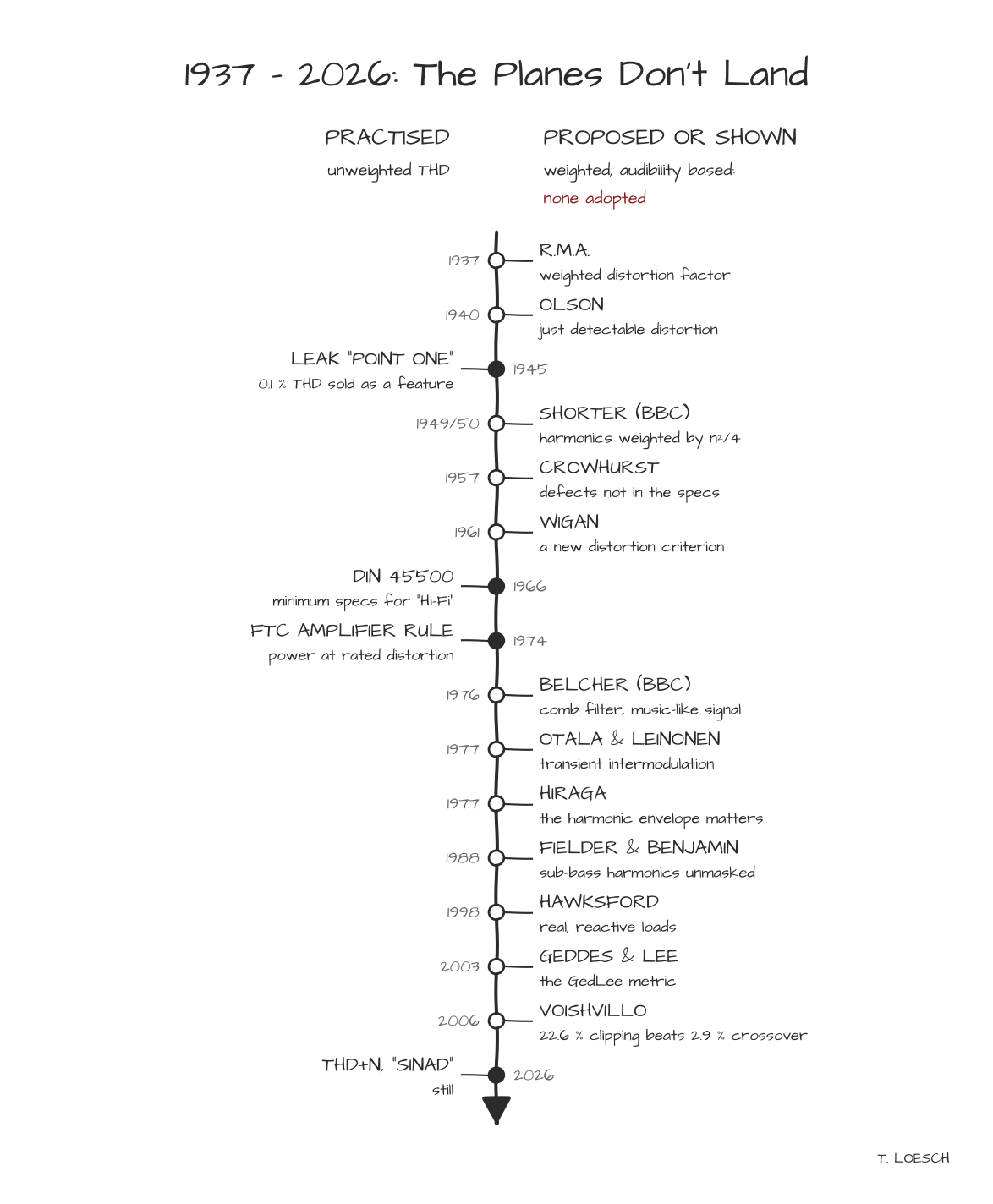
| Who | When | What was proposed or shown | What became of it |
|---|---|---|---|
| R.M.A. (Radio Manufacturers’ Association) | 1937, Journal of the IEE, and the discussion in the IEE Wireless Section | A weighted distortion factor in place of unweighted RMS, because it was “easier for workers to base their experience on the weighted than on the unweighted factor” | Proposed, never adopted |
| Harry F. Olson (RCA) | 1940, Elements of Acoustical Engineering (revised 1947; Acoustical Engineering, 1957), under Nonlinear Distortion | Thresholds of just detectable distortion (JDD) | Ignored |
| D.E.L. Shorter (BBC) | 1949, BBC Research Department report; 1950, Electronic Engineering | Weight each harmonic by its order. A weighting of n²/4 for the nth harmonic matched listeners’ rankings; n/2 did not | Ignored |
| Norman H. Crowhurst | 1957, JAES | Defects in amplifier performance not covered by standard specifications | Ignored |
| E.R. Wigan | 1961, Electronic Technology | A new distortion criterion, based on a closer correlation between objective measurement and subjective assessment | Ignored |
| R.A. Belcher (BBC) | 1976, BBC Research Department report | A comb-filter method: distortion measured with a dynamic, music-like signal instead of static tones. The first institutional attempt of its kind, it correlated far better with listeners’ impairment scores than THD | Not adopted |
| Matti Otala and E. Leinonen | 1977, IEEE Transactions on Acoustics, Speech, and Signal Processing | The theory of transient intermodulation distortion (TIM): mechanisms that cause audible non-harmonic distortion | Not adopted |
| Jean Hiraga | 1977, Hi-Fi News & Record Review | The absolute THD figure is irrelevant to the ear. What matters is a smoothly, monotonically decaying harmonic envelope (H2 > H3 > H4 > H5 …). An amplifier with 1 % THD can sound natural if its distortion spectrum follows the ear’s masking; one with 0.001 % sounds fatiguing if the pattern is jagged, or if high orders (H7, H9) stand above lower ones | Not adopted |
| Louis D. Fielder and Eric M. Benjamin | 1988, JAES | High-order harmonics of sub-bass tones clear the masking thresholds once they reach the mid-band, despite very low levels | Not adopted |
| Malcolm O. J. Hawksford | 1998, AES 14th International Conference | Error-nulling bridges isolate the raw distortion residual into complex, reactive loads with back-EMF. An amplifier behaves very differently delivering current into a real crossover and voice coil than into a laboratory resistor, and feedback loops misbehave fighting the stored energy | Not adopted |
| Earl R. Geddes and Lidia W. Lee | 2003, AES 115th Convention (paper 5891) | The GedLee metric (Gm), from the shape of the nonlinear transfer function. It tracked listener ratings where THD and IMD did not | Ignored |
| Alexander Voishvillo | 2006, AES 121st Convention (paper 6910) | Hard-clipped music measuring 22.6 % THD was judged less objectionable than 2.9 % THD from crossover distortion. The type of distortion, and its fit to auditory masking, matters far more than the lumped number | Not adopted |
PEAQ (ITU-R BS.1387) is not on this list. It is narrowly defined, for codecs, and is not applied in any general way.
Appendix: Criticism and review of ABX audio testing
Leventhal (1986) showed that while ABX testing is tightly optimised to avoid Type 1 errors (false positives: claiming to hear a difference that isn’t there), small sample sizes and typical trial counts (for example 16 trials) give it abysmally low statistical power. This biases the test towards false negatives (Type 2 errors), and leads objectivists to conclude, mistakenly, that “no audible difference exists” when the test was simply underpowered.
Leventhal and Huynh (1996) show how one-tailed and two-tailed statistical analysis applies to binomial audio experiments, and set out how significance thresholds must change depending on whether the tester predicts a specific outcome or general audibility.
Boley and Lester (2009) show that standard ABX tests confound a listener’s actual sensory sensitivity with their internal response bias (for example, a conservative tendency to answer “A” or “B” under fatigue). With signal detection theory’s d′ (discriminability index) and β (decision criterion), researchers can separate true perceptual accuracy from guessing patterns.
Zieliński, Rumsey and Bech (2008) give a complete review of the experimental and cognitive biases built into standard listening-test protocols, showing that even strict listening tests are corrupted by non-auditory variables.
Tabas, von Kriegstein and colleagues (2020) show that expectation shapes hearing as early as the subcortical auditory pathway: the subject hears what it expects to hear, as opposed to the acoustic stimulus that is present. Nothing in ABX removes this. As long as the listener is invested in the outcome of the test, the listening bias stays.
Taken together, I read these findings as follows. ABX does not remove listening bias. A listener invested in the outcome brings expectations that shape hearing as early as the subcortical auditory pathway (Tabas et al.). Repeated forced choices under fatigue add response bias (Boley and Lester). Non-auditory variables corrupt the rest (Zieliński et al.). The structure of the test amplifies these biases rather than controlling them.
All this leaves ABX as a highly criticised test: abysmally low statistical power as usually run, a high risk of false negatives, corrupted by non-auditory variables, its biases amplified rather than removed, ON TOP of being unable to provide ANY actionable design information. ABX is an extremely blunt tool to accomplish nothing.
References
Cargo cult science
- Richard P. Feynman, “Cargo Cult Science”, Caltech commencement address, 1974.
Fidelity to what? The circle of confusion
- Sean E. Olive, “The Preservation of Timbre: Microphones, Loudspeakers, Sound Sources and Acoustical Spaces”, 8th International AES Conference: The Sound of Audio, May 1990.
- Floyd E. Toole, Sound Reproduction: The Acoustics and Psychoacoustics of Loudspeakers and Rooms, Focal Press.
- J. Gordon Holt, “Why Hi-Fi Experts Disagree”, Stereophile, February 1963.
Failed attempts
-
“R.M.A. Specification for Testing and Expressing the Overall Performance of Radio Receivers”, Journal of the Institution of Electrical Engineers, Vol. 81, Issue 487, 1937.
-
“Overall Performance of Radio Receivers: Discussion”, Proceedings of the Wireless Section of the I.E.E., Vol. 12, No. 34, pp. 12–22, March 1937.
-
Harry F. Olson, Elements of Acoustical Engineering, D. Van Nostrand, New York, 1940 (revised 1947; as Acoustical Engineering, 1957). Chapter 8 (section 6.26 onwards in later editions), Nonlinear Distortion and the threshold of just detectable distortion.
-
D.E.L. Shorter, “An investigation into non-linear distortion: first interim report”, BBC Research Department Report No. 1949/30, 1949.
-
D.E.L. Shorter, “The influence of high-order products on non-linear distortion”, Electronic Engineering, Vol. 22, No. 266, pp. 152–153, April 1950.
-
N. H. Crowhurst, “Some Defects in Amplifier Performance Not Covered by Standard Specifications”, JAES, Vol. 5, No. 4, pp. 195–202, 1957.
-
E.R. Wigan, “New distortion criterion: a new way of measuring non-linear distortion based on a closer correlation between objective measurements and subjective assessment”, Electronic Technology, Vol. 38, No. 4, pp. 128–137, 1961.
-
R. A. Belcher, “Audio non-linearity: A comb-filter method for measuring distortion”, BBC Research Department Report No. 1976/12, 1976.
-
M. Otala and E. Leinonen, “The Theory of Transient Intermodulation Distortion”, IEEE Transactions on Acoustics, Speech, and Signal Processing, Vol. 25, No. 1, 1977.
-
J. Hiraga, “Amplifier Musicality: A Study of Amplifier Harmonic Distortion Spectrum Analysis”, Hi-Fi News & Record Review, March 1977 (reprinted in audioXpress, March 2004).
-
L. D. Fielder and E. M. Benjamin, “Subwoofer Performance for Accurate Reproduction of Music”, JAES, 1988.
-
M. O. J. Hawksford, “Towards a More Objective Appraisal of Audio Amplifier Performance”, AES 14th International Conference: Audio, Acoustics & Small Spaces, 1998.
-
Earl R. Geddes and Lidia W. Lee, “Auditory Perception of Nonlinear Distortion”, AES 115th Convention, 2003, paper 5891.
-
Alexander Voishvillo, “Assessment of Nonlinearity in Transducers and Sound Systems: From THD to Perceptual Models”, AES 121st Convention, San Francisco, October 2006, paper 6910.
ABX
- Les Leventhal, “Type 1 and Type 2 Errors in the Statistical Analysis of Listening Tests”, JAES, Vol. 34, No. 6, pp. 437–453, 1986.
- Herman Burstein, “Approximation Formulas for Error Risk and Sample Size in ABX Testing”, JAES, Vol. 36, No. 11, pp. 879–883, 1988.
- Les Leventhal and Cam-Loi Huynh, “Analyzing Listening Tests with the Directional Two-Tailed Test”, JAES, Vol. 44, No. 10, pp. 850–863, 1996.
- Jon Boley and Michael Lester, “Statistical Analysis of ABX Results Using Signal Detection Theory”, AES 127th Convention, 2009, paper 7826.
- Sławomir Zieliński, Francis Rumsey and Søren Bech, “On Some Biases Encountered in Modern Audio Quality Listening Tests: A Review”, JAES, Vol. 56, No. 6, pp. 427–451, 2008.
- Alejandro Tabas, Glad Mihai, Stefan Kiebel, Robert Trampel and Katharina von Kriegstein, “Abstract rules drive adaptation in the subcortical sensory pathway”, eLife 2020;9:e64501. Summarised by TU Dresden: We hear what we expect to hear.