
Article
This Is Why You Want Dipole Speakers
Room modes, boundaries and reverberation: why an open baffle, and why not for the bass, by Thorsten Loesch.
Original title: Why Dipole Speakers
Dipole SpeakerOpen Baffle SpeakerSpeaker TheoryRoom Acoustics25 or 6 to 4? Or zero to 8.
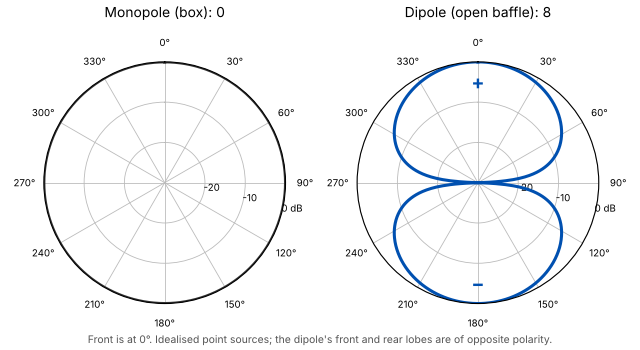
Q: Where is the box in that speaker?
A: Why would you want one? The box itself is a problem, the way it interacts in a room is another. What you want, really, really want, is a dipole speaker.
Not for the bass. Low bass from a dipole is possible, but it is a fool’s errand: front and back wave cancel, and the longer the wavelength, the more they cancel. Very low bass we can leave to a boxy subwoofer.
The reason for a dipole sits higher up, in the upper bass, the lower midrange and the low formant region of the voice. That is where most loudspeakers and most rooms disagree with each other. Dipoles, well, they agree a lot more than they disagree.
Why the sound in the room, as the listener hears it, counts for more than a flat on-axis curve, one more FOM: figure of merit. A single number, such as THD+N, SINAD or jitter in picoseconds, used to sum up signal fidelity, with the claim that a better number means better sound. It relates to audible fidelity only at the extremes. The Audio Heretick's Progress: the FOM → that is frequently quoted but grossly fails as a measure of audible fidelity, is set out in my position paper The Audio Heretick’s Progress.
Three things happen there.
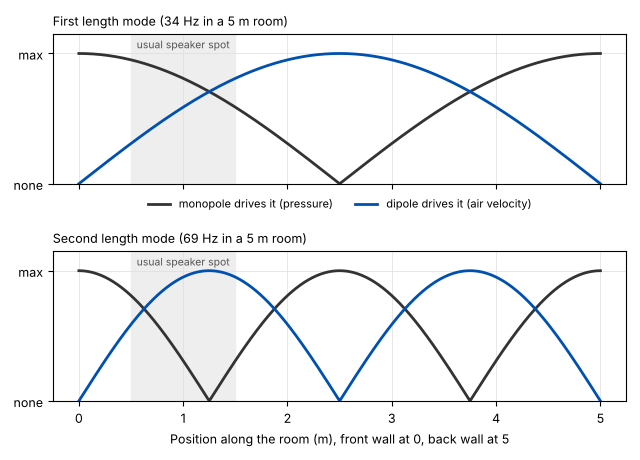
Room modes. A normal box speaker is a monopole. It pushes air out in all directions at once, so it excites a room mode most where that mode’s pressure is highest: at the walls and in the corners. Put a box near a wall and you hear it. A dipole pushes forward and pulls backward at the same time. It excites a mode most where the air moves fastest, and for the lowest modes that is near the middle of the room, not where speakers usually stand. It also mainly drives the modes along its own axis, front to back. The modes between the side walls, and between floor and ceiling, get much less. So the only place a box speaker leaves the room modes mostly alone is far out in the open, in the middle of the room, exactly where it does the most damage to any home decor. A dipole is happiest where it is relatively out of the way.
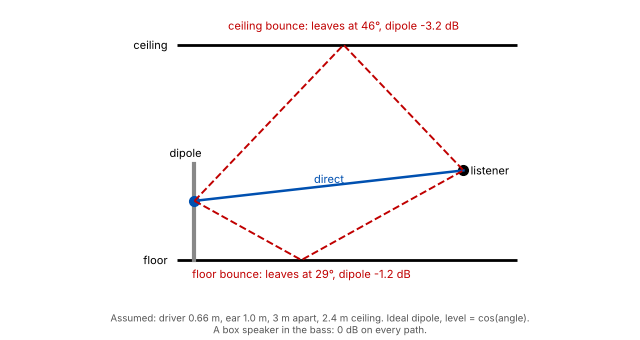
Boundaries. In the bass a box radiates in every direction, so floor, ceiling and side walls all send back a strong, slightly late copy of the sound. Where that copy arrives out of phase, we get deep suck-outs. A dipole has its nulls to the sides, above and below. Against the side walls this helps a lot. Against the floor bounce at a normal listening distance it helps less than one might hope, a dB or so, because that reflection leaves the baffle at a shallow angle.
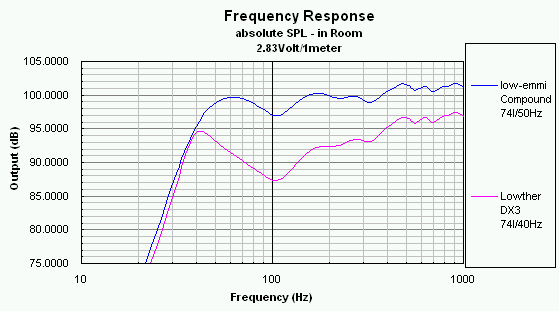
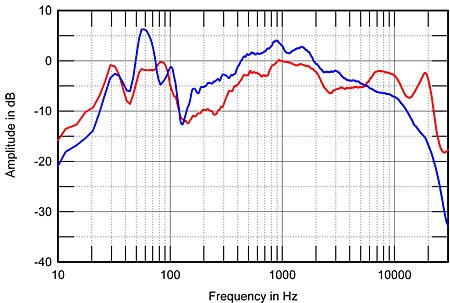
Two in-room measurements, drawn to the same scale, show the difference.
The first is a dipole: a pair of Transparence open baffles in a domestic room, left and right channel, no subwoofer.
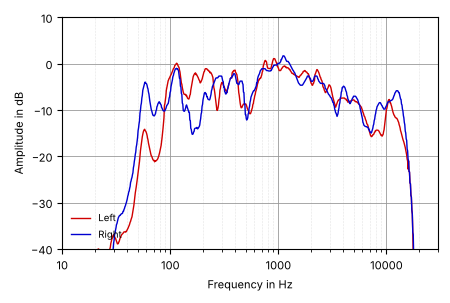
The second is the box: two expensive commercial speakers in one writer’s room, smoothed and averaged over several positions. It was simply the first such graph I found on Stereophile’s site; no criticism of the products is intended.
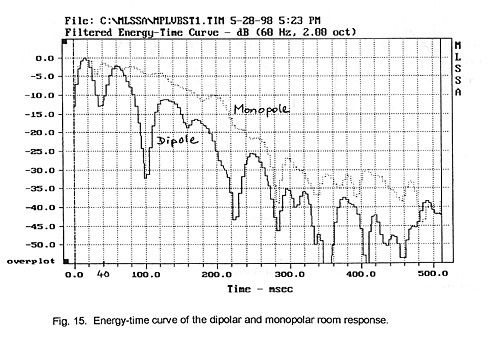
Reverberation. Higher up, a box speaker is fairly directional, with a directivity index of 6 dB or more. In the bass this falls to 0 dB: the box sprays the same energy in every direction, and the room answers with reverberation. Modern, bare rooms answer loudly. A dipole keeps its figure of eight, and with it a directivity index of about 4.8 dB, all the way down. For the same level at the listener it puts only a third of the power into the room. This is the loudspeaker case in my position paper’s Stage 6: flat on-axis is not enough; what the room does with the rest decides what we hear. In my own tests, same room, same position, the decay times measured at the listening position (RT20 and RT60) were much shorter with the dipole than with a monopole. Those measurements are lost to the ravages of time, but Siegfried Linkwitz found the same, independently, in 1998. His energy-time curve for the band around 60 Hz is telling: from about 150 ms on, the dipole sits roughly 10 dB below the box, and it reaches -40 dB about 100 ms sooner.
How to read it: the graph shows how the sound energy at the listening position dies away after a short burst of sound in a band around 60 Hz, two octaves wide, much like a 60 Hz tone burst. Time runs left to right in milliseconds, level is in dB below the peak. The faster the curve falls, the less the room keeps ringing. The solid line is the dipole, the dotted line the box (monopole), same room, same position.
Getting the same result with a box speaker means room treatment, and treatment that works in the upper bass and lower midrange is big, heavy and anything but cheap. A dipole does it for free.
The net result: less room, more music. Less of our room means the recording’s own space gets a chance: a better illusion (Stage 4). A dipole gives more direct sound and less room sound, and boundaries bother it little. The exception is the wall behind it, which it hears loud and clear, so give it some space.
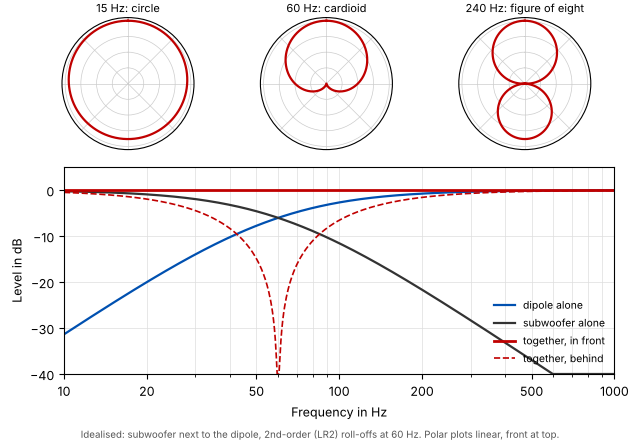
Hey DJ … where’s the bass? The dipole roll-off is gentle. With a roll-off around 60 Hz we get a second- to third-order slope, which joins a simple subwoofer very well. Place the subwoofer, a monopole, close to the dipole and something neat happens. As the frequency falls, the radiation pattern changes from a figure of eight, through a cardioid, to a circle. Only the very lowest frequencies are left to the subwoofer alone, often below the lowest room modes in normal-sized rooms.
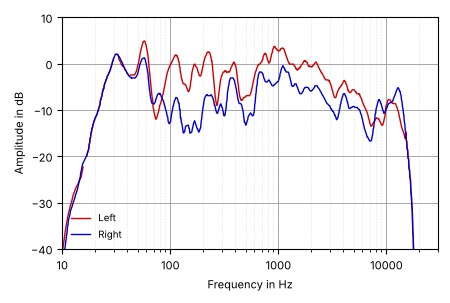
Here is the same pair of Transparence speakers with a sealed subwoofer added, a Linn Isobarik 2150, in the AnandTech review system. Compare it with the dipole-only graph above: the bass now reaches down to about 30 Hz.
The simplest dipole
The simplest dipoles are a full-range electrostatic speaker, such as the Quad ESL63, or an open baffle with a so-called full-range driver.
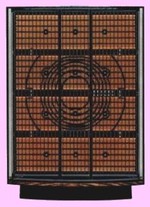
Left: Quad ESL63.
A full-range electrostatic dipole.
92.5 cm high, 66 cm wide.
86 dB/2.83 V/1 m.
Right: Transparence.
A full-range driver on an open baffle.
106.7 cm high, 61 cm wide.
About 94 dB/2.83 V/1 m.
Quad image: Quad, via adrian-kingston.com.
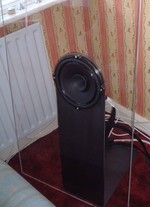
The full-range driver brings two gifts of its own. At higher frequencies its rear radiation is strongly attenuated by the basket and magnet, which cast an acoustic shadow. So the speaker can stand closer to the wall behind it with less acoustic treatment, or none. To the front, a full-range driver becomes fairly directional at high frequencies. That keeps the side walls and the rest of the room out of the treble as well, and with it a good share of the room sound.
At low frequencies the wall behind can be put to work. The rear wave is inverted, travels to the wall and back, and arrives late. When that delay is half a period, it adds to the front wave instead of cancelling it. With the speaker 1 m from the wall the extra path is about 2 m, and the reinforcement falls around 85 Hz. An octave higher, near 170 Hz, the same reflection cancels instead, so this is a trade to be tuned, not a free lunch. Tune it with a noise signal and a spectrum analyser, not with a windowed MLS measurement: windowing cuts the room out, and the room is exactly what we are tuning here.
Which brings us to the Transparence
That brings us neatly to the Transparence, a full-range open-baffle speaker built on exactly this thinking, and part of the answer to why full range. Its radiation pattern in the upper midrange and treble adds to the shorter decay times: there is simply less energy going off axis, so there is less level to start with, and the room sound falls to a given level below the direct sound sooner.
Further reading
Siegfried Linkwitz, “Investigation of Sound Quality Differences between Monopolar and Dipolar Woofers in Small Rooms”, AES 105th Convention, San Francisco, September 1998, preprint 4786. Online copy at Linkwitz Lab.
This is a thorough and extensive investigation, far beyond our quick overview. It covers the mode coupling and the reverberant field in great detail, with extensive measurements.