

Design
This Is the Legacy, a Universal DHT Power Amplifier
A single-ended 300B amplifier with a pentode driver and a valve-regulated supply, by Thorsten Loesch.
Original title: The Legacy Power Amplifier
Legacy300BTube Amp Theory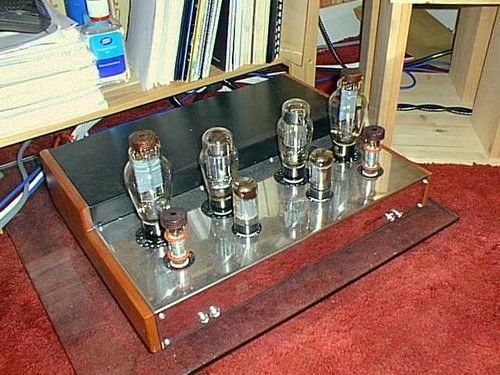
This design started life as a fairly faithful reproduction of the “Legacy” amplifier from La Maison de l’Audiophile, designed by Wilhelm Walters and Jean-Constant Verdier. It is among the very best commercially produced 300B amplifiers I have ever encountered.
Credit where it is due
Thanks to David Chessel of Alema Ltd (Audion, Edison, AMP) for providing the mechanical parts and transformers of the Edison 60 kit, which were used as the basis for the amplifier. Thanks are also due to Eric Barbour of Svetlana for samples of the Svetlana 300B, and to George Hawthorne for a pair of 45 valves. Another big round of thanks to my friend Jon Finlayson for helping to obtain many of the parts, especially the custom-made Ansar Supersound polypropylene capacitors used throughout the amplifier, and for getting me two pairs of the superb Siemens C3m pentode from Australia. Thanks also to Jean-Constant Verdier for sharing his design for the power supply in Sound Practices and his design of the EL84 driver stage. And I am indebted to Ronald Koridon for suggesting this amplifier to me.
The amplifier
In many ways this amplifier could be called the “ultimate” WE 91. While investigating the old Western Electric design I noticed many things, but one stood out: how much lower the distortion of a correctly designed pentode driver stage is. The drawback of the original is the very high output impedance of its driver stage, which causes a treble roll-off and poor current delivery. In the Legacy the WE 310 driver valve is replaced by a much meatier EL84 (or, as I did later, a Siemens C3m). This gives the driver stage an output impedance ten times lower than in the original WE design, and it can deliver more than eight times the current.
With around 16 mA operating current, the driver stage has enough current available to drive the capacitive load of the 300B grid with a full-level signal up to 500 kHz before it would slew. Together with the driver’s output impedance, the 300B input capacitance rolls the bandwidth off at around 190 kHz, so no signal that reaches the grid can make the driver slew: it will under NO conditions run into slewing. The not inconsiderable grid current of the 300B on peaks can also be supplied, which allows better power delivery. In short, the driver stage of this amplifier is not the limiting factor, neither for bandwidth nor for linearity.
The 300B output valve and the output transformer dominate the performance of this amplifier entirely. For the output valve many options exist, and mostly you get what you pay for. I like Svetlana and WE 300Bs best, but the latest batch of Reflektor (Sovtek) 300Bs I obtained is also excellent and close to the Svetlana, much better than the earlier Sovtek 300Bs. The output transformer is the one from the Edison 60 kit. In this amplifier it is heavily over-dimensioned, with a huge core and power capacity. Its primary inductance is high enough to allow the transformer to be mismatched (an 8 Ohm load connected to the 4 Ohm tap), which gives a nominal primary impedance of 4800 Ohm, useful with many of the interesting RCA valves (45, 50), as we will see later.
The audio circuit for one channel is shown below. Apart from the beefier driver stage, it is classic Western Electric. The driver valve can be a Svetlana SV83 or any other EL84-compatible valve.
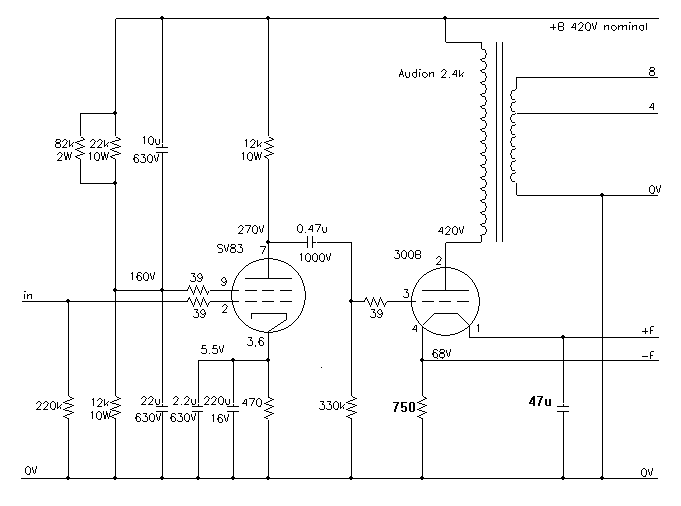
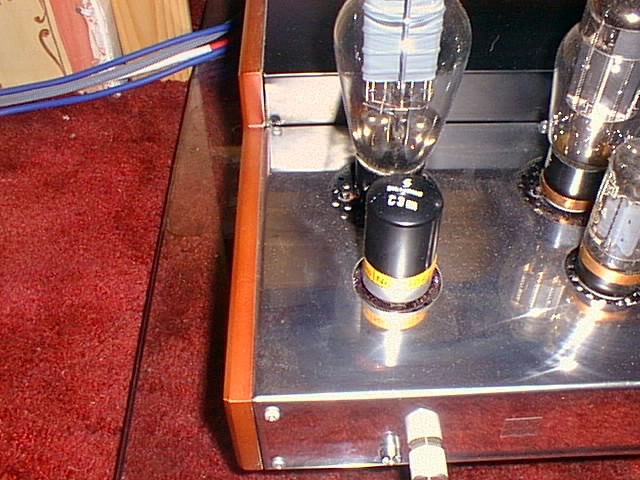
Since drawing this circuit I have changed the driver valve to the Siemens C3m (the TS49 and PT49 are equivalents). The changes are minimal: the 82k resistor in the voltage divider for g2 is removed, the cathode resistor becomes 250 Ohm, and the anode voltage is nominally 225 V. Of course a loctal socket must be fitted for the C3m, and the pinout is different.
The power supply
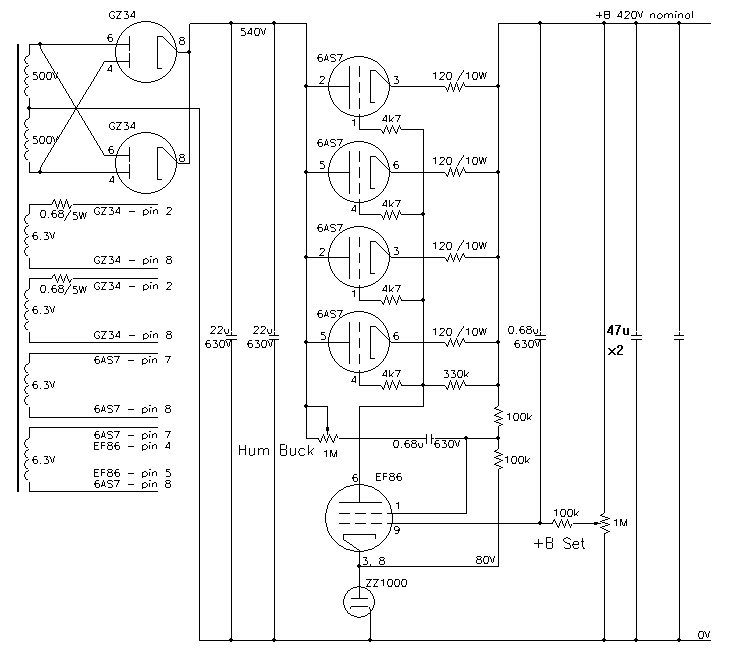
One of the main innovations of this amplifier is actually the power supply. It is fully regulated, using valves. I will not insist on the benefits of such an arrangement here; instead I suggest reading Jean-Constant Verdier’s excellent Sound Practices article. I have progressed further from the original design. After comparing the sound of a neon reference against Zener diodes, I found I preferred the neon and kept it.
In addition I have tuned the open-loop bandwidth and gain of the regulator so that above around 150 Hz it no longer carries the signal current; instead it hands over to a pair of 47 µF/450 V Ansar Supersound capacitors. So the regulator provides a low impedance at very low frequencies, where a ridiculously large capacitor would otherwise be needed, while in the range where most musical information lies, the supply impedance is set by very high-quality capacitors. The rectification uses GZ34 valves. They give a slow turn-on, so the resistors bridging the regulator valves in the original design can be dispensed with, which again improves the sound.
Using two rectifier valves and only 40 µF of total reservoir capacitance makes for a raw, unregulated B+ that is pretty brawny but fast, and that reduces the pulsing of the mains transformer. This of course leads to a lot of ripple, but the active regulation offers tremendous ripple suppression: less than 10 mV of hum on the 420 V rail under full load. The output hum of the amplifier in the system is around 0.5 mV when adjusted optimally.
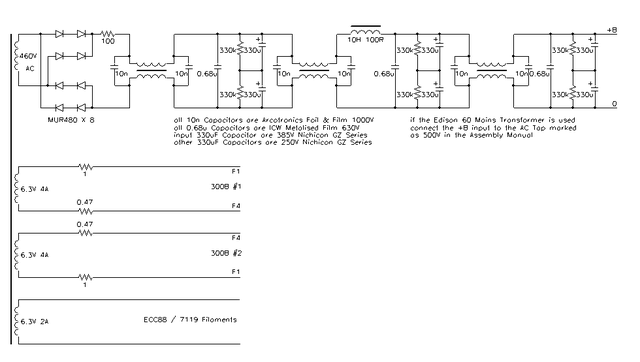
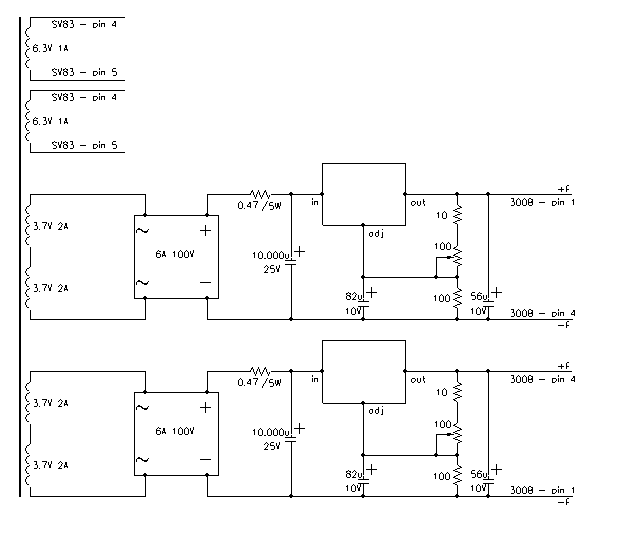
The heater supply is simple: an LT1085 in each channel regulates the heater voltage of the output valve. As shown, it can be adjusted over the full range from 2.5 V to 7.5 V, so a wide range of output valves can be used. At 2.5 V the full 2.5 A for a 2A3 is available; at 7.5 V the current capacity falls to around 1.5 A.
Parts
The parts quality is at my usual high standard. All capacitors in the power supply and the 300B cathode bypass capacitors are Ansar Supersound, custom-made metallised polypropylene in metal cans. The capacitors bypassing g2 of the driver stage are also Ansar, but conventional ones. The cathode bypass capacitor of the driver valve is an Elna Silmic, further bypassed with Ansar Supersound. The coupling capacitor is an ERO KP1832 from Steinmusic in Germany.
All capacitors carry the complete recommended bypassing: 3600 pF ERO KP1832, 2700 pF NFS polystyrene (“Styroflex”) and a further 2200 pF silver mica. Larger capacitors have an additional ERO KP1832 0.075 µF/800 V bypass.
All resistors are my usual new-old-stock non-inductive, non-magnetic wirewounds; the closest modern equivalents are Mills or Dale. The grid stoppers and the 300B grid leak resistor are Allen-Bradley carbon composition. All adjustable resistors are 18-turn Vishay cermet types. The internal wiring is mostly solid silver in Teflon, with solid-core copper in PTFE insulation for the power supply. Everything is hard-wired; there is no PCB.
Sound and use
The amplifier sounds very good, with excellent bass and control. It has easily held its own against many highly regarded commercial 300B SET amplifiers.
It was voiced with Beauhorn Virtuoso speakers, but has also been used with a wide range of others, from the 89 dB/W/m, 4 Ohm Orchid Audio PLL-1 monitors all the way to my own 102 dB/W/m “Magnificat” speakers, and electrostatic speakers as well. It has been used with a wide range of output valves, including most current makes of 300B, various new and old stock 2A3s and 45s, offering tremendous sound in each case, according to the valve used. Mostly I use Svetlana 300Bs.
Power with the 300B at nominal settings (425 V B+) is 8 W.
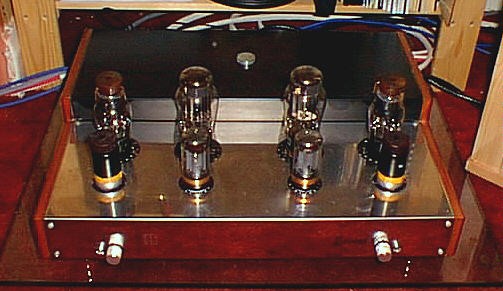
The thinking behind this amplifier, and why a pentode driver, is set out in Some Thoughts about Single-Ended Valve Amplifiers. There, the EL84 pentode driver measured best of the four driver stages compared. A later take on the WE 91, with a reactive interstage instead of a beefier pentode, is The Lux91 MonoMax.
In the terms of my position paper The Audio Heretick’s Progress, the Legacy was voiced by ear for audible fidelity; the figures above are FOM: figure of merit. A single number, such as THD+N, SINAD or jitter in picoseconds, used to sum up signal fidelity, with the claim that a better number means better sound. It relates to audible fidelity only at the extremes. The Audio Heretick's Progress: the FOM → and tell only the signal fidelity part of the story, nothing about audible fidelity.