
Article
This Is the Transparence: One Driver, One Clear Baffle, No Crossover
An open-baffle loudspeaker, from a 2003 DIY project to a run of ten commercial pairs, by Thorsten Loesch.
Original title: Transparence
TransparenceThe Transparence is an open-baffle (dipole) loudspeaker. Each speaker is a single 215 mm Supravox 215 Signature Bicone full-range driver mounted on a clear acrylic baffle, with no crossover. It began in 2003 as a DIY project and was then built commercially: ten pairs were made.
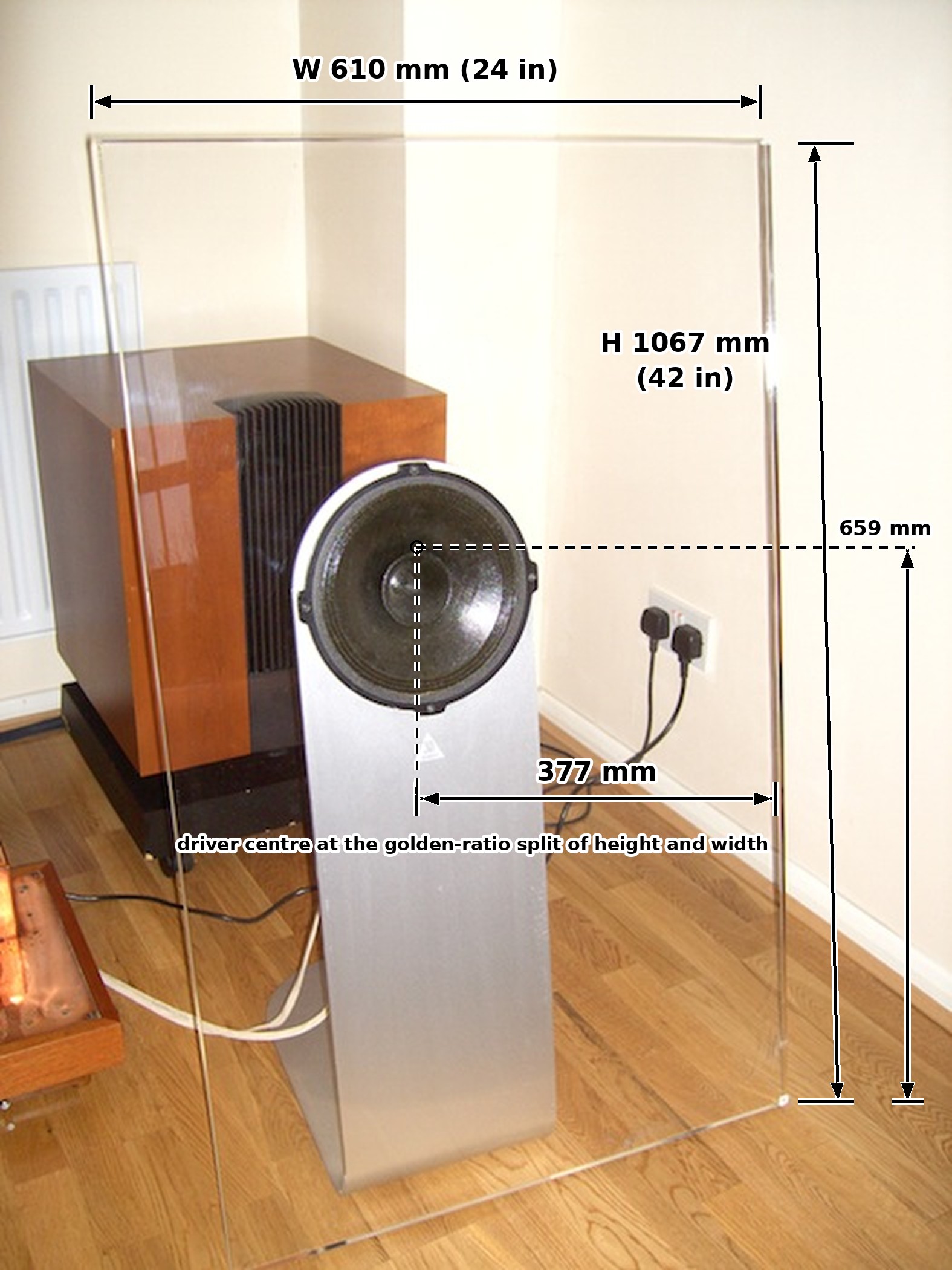
Dimensions
| Baffle | 610 × 1067 mm (24 × 42 in), clear acrylic |
| Driver | Supravox 215 Signature Bicone, 215 mm |
| Crossover | none |
| Mounting | one metal L-piece, four brass screws and nuts; cable attached directly to the driver |
| Driver centre, horizontal | 233 mm from the inner edge, 377 mm from the outer edge |
| Driver centre, vertical | 659 mm from the bottom edge, 408 mm from the top |
The drivers are mirrored, so the left and right speakers are symmetric. Normally the shorter distance (233 mm) is placed on the inside, but that is not a rule.
Golden-ratio placement
The driver position follows the golden ratio. The baffle width of 610 mm divides into 233 mm and 377 mm, a ratio of 1 : 1.618. The height of 1067 mm is divided the same way, into 408 mm and 659 mm. The driver centre sits on both divisions, so the driver is not centred.
The baffle itself is not a golden rectangle: 1067 / 610 = 1.75, not 1.618. The ratio applies to where the driver sits, not to the outline.
The driver diameter of 215 mm is 35 % of the baffle width and 20 % of its height. With the centre 233 mm from the inner edge, the nearest edge of the driver cone frame is about 125 mm from the inner edge of the baffle, and about 269 mm from the outer edge.
Why place it so? With the driver centred, its distances to the left and right edges are equal, so the edge diffraction contributions arrive at the same time and reinforce each other at certain frequencies. Unequal distances spread those ripples across frequency instead of stacking them, simple. Why the golden ratio? It is simple, visually appealing and makes sure no dimensions repeat.
Impressions
These are my impressions from 2003, written on the diyAudio forum shortly after the first pair was built. They are subjective.
- Coherent, open and balanced. Full-range enough that I did not feel the need for a subwoofer or supertweeter.
- Slightly louder than my Bastanis baffles and a little less than Tannoy Monitor Reds, and noticeably louder than a Beauhorn B2.2.
- Acrylic sounds more literal and drier than plywood. Against the Tannoys: more directness and immediacy. The Tannoys play louder and go lower.
- Bass extension subjectively well into the 50 Hz range, placement dependent.
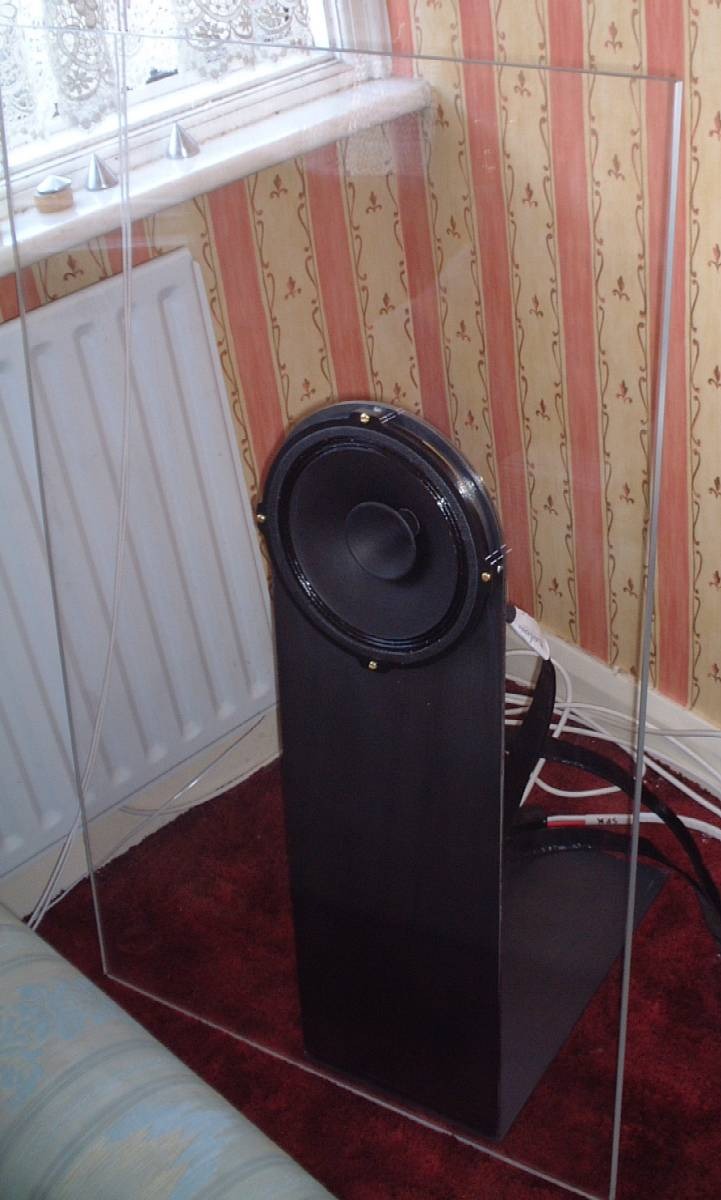
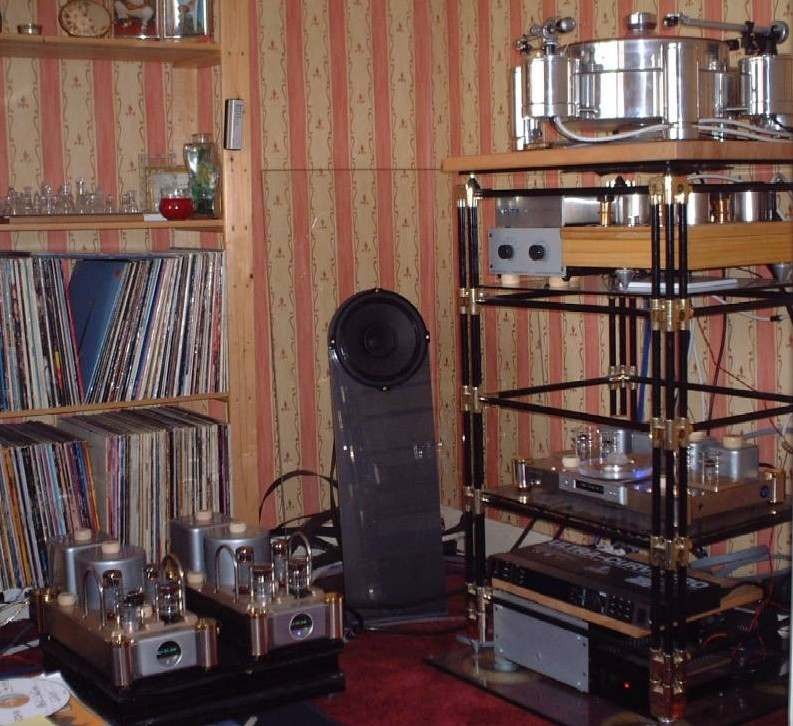
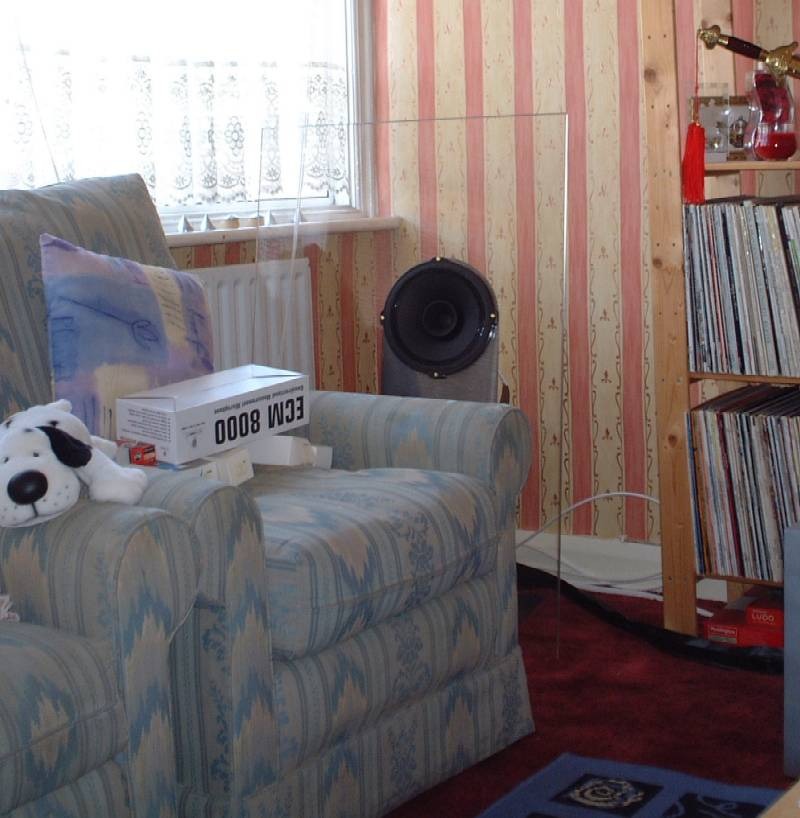
Photographs
Subwoofer
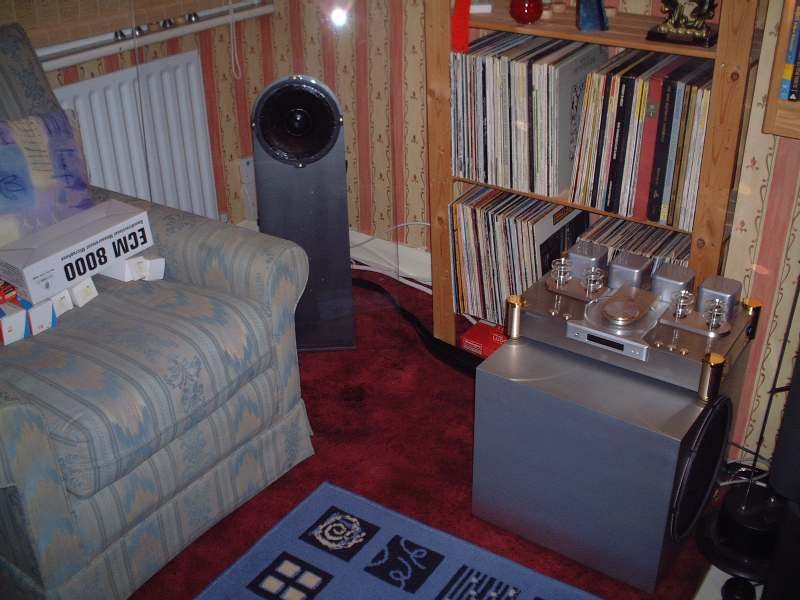
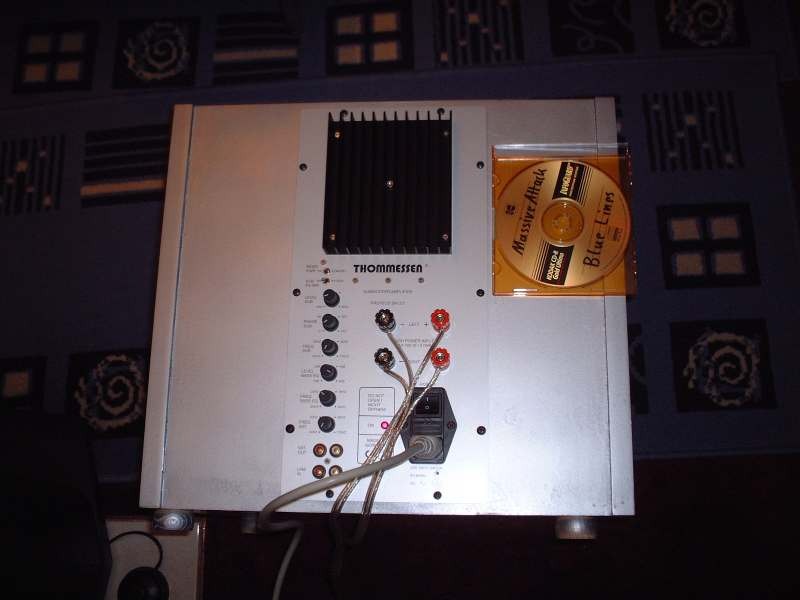
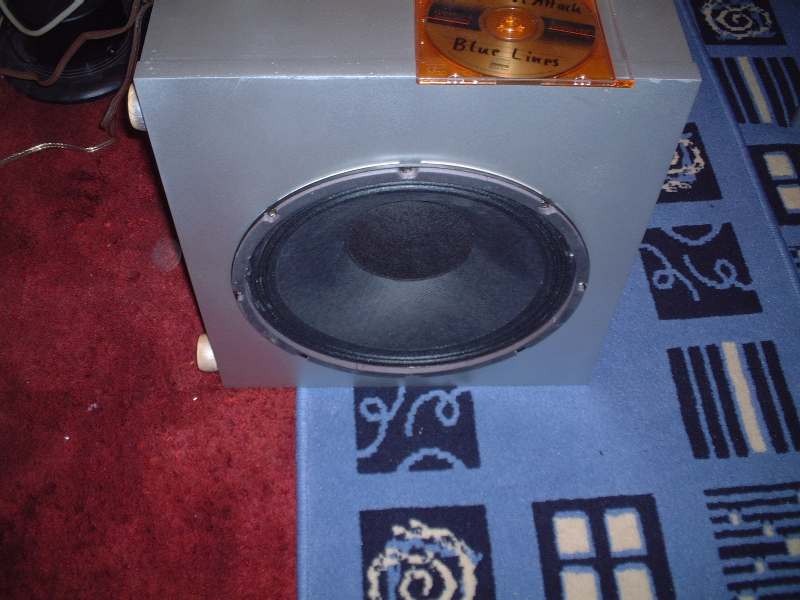
The Transparence works without a subwoofer. In my own system I also ran it with one. It is a closed box of 5/8 in MDF, painted silver, with a plate amplifier from Thommessen on the top. The woofers are 12 in drivers from the Bastanis Prometheus kit, which I believe are based on the Eminence Delta 12LF. There are two, mounted on opposing sides of the box so that their motion cancels. The photographs show the driver on the front.
Crossed over at 40 Hz and with +6 dB at 30 Hz, the combination had strong impact. No equalisation was used.
Origin
The idea comes from a Swiss design, the LuiLui.
The Transparence is not a copy of it: materials, driver, dimensions, driver placement and appearance differ.
The project is discussed in the thread Are you (open) baffled yet? on diyAudio, started in September 2003.
Review and measurements
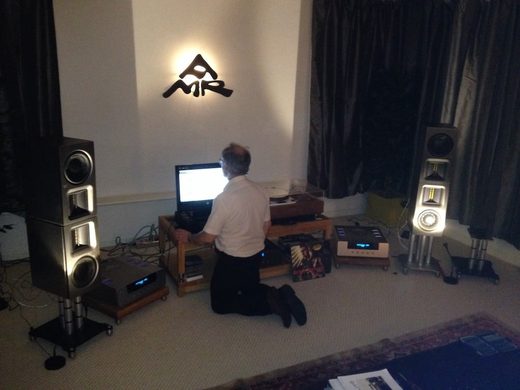
The Transparence was reviewed by AnandTech. The original page is gone; it survives in the Internet Archive: AnandTech, print/2677 (Wayback Machine). The photograph above is from that review and remains the property of its author.
Measurements
I measured my own system, the one with the striped wallpaper in the photographs, but those measurements were never published and are lost, together with other documentation. The two graphs below are from the AnandTech review (see above), in-room responses of a pair of Transparence speakers, alone and with a sealed subwoofer, a Linn Isobarik 2150. Red is the left speaker and blue the right. This is a different subwoofer from mine. The values in the text are approximate readings from the graphs, not data.
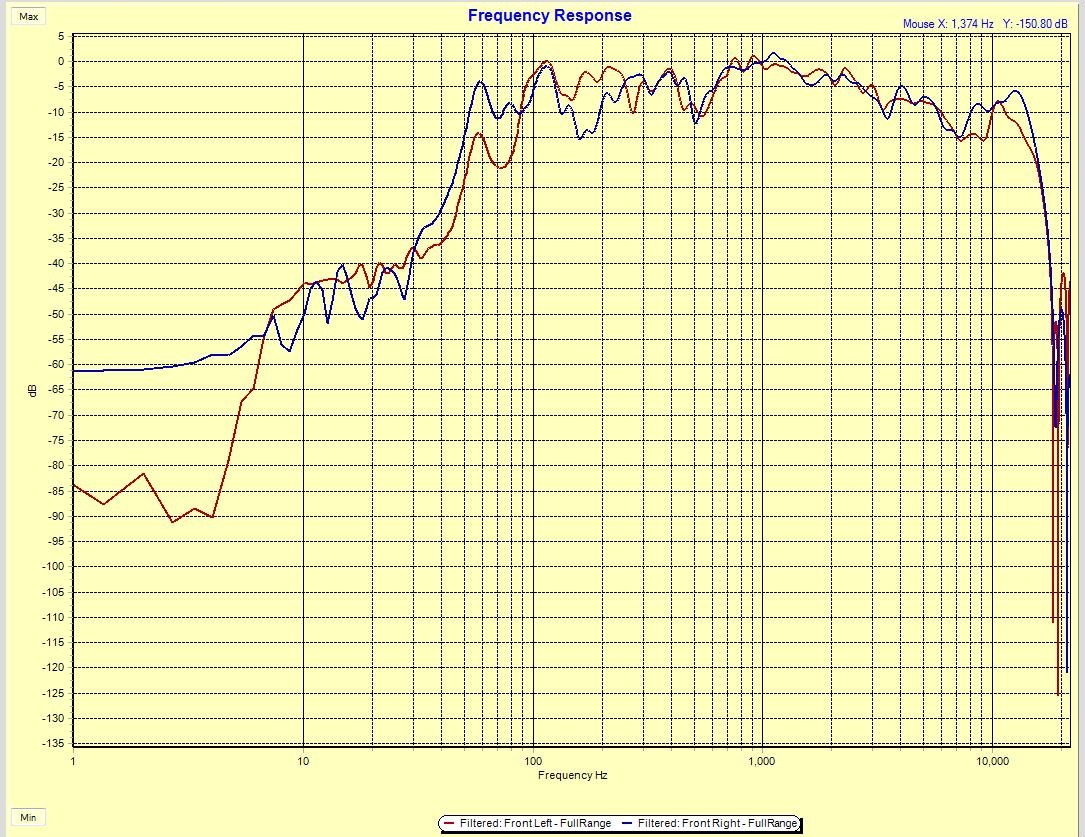
Without a subwoofer the trend of the response from about 100 Hz to about 8 kHz stays within about ±5 dB. There are some narrow dips, likely from room resonances. Different placements change the response. Below about 60 Hz the output falls quickly: at 60 Hz it is about -4 dB for one speaker and -14 dB for the other, and it is down by about 40 dB at 30 Hz. Above about 15 kHz the response drops steeply.
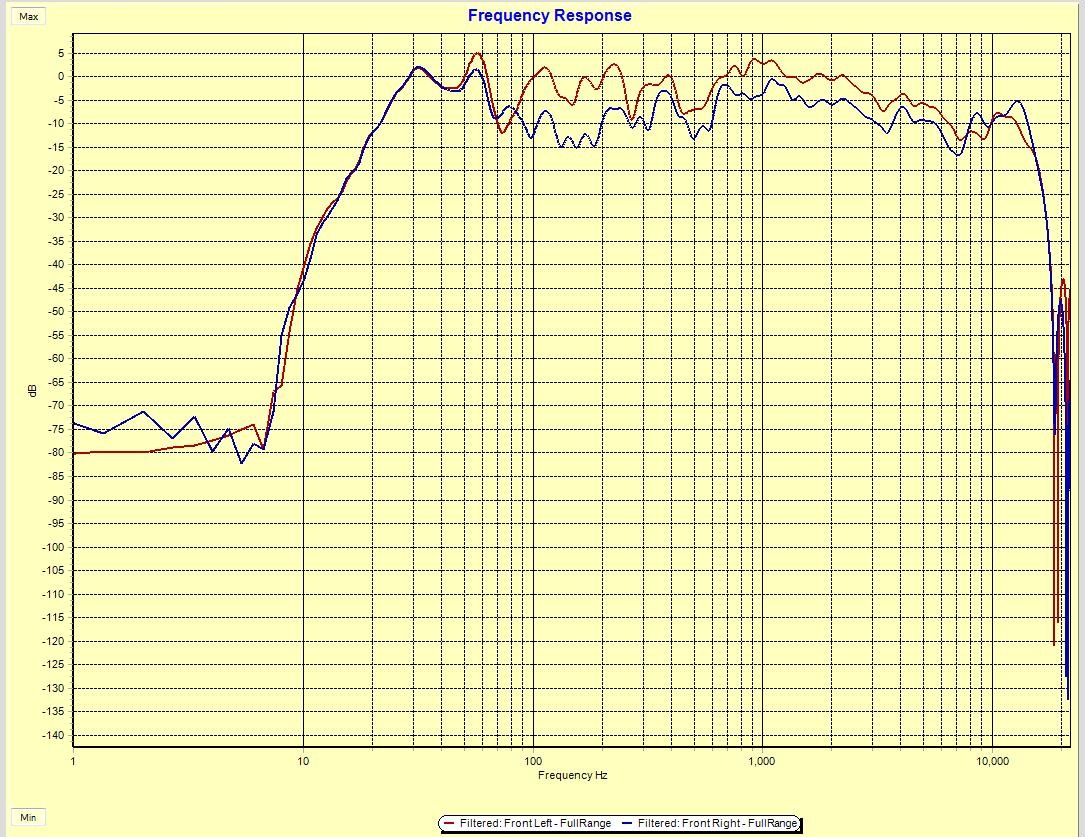
With the subwoofer the response extends to about 30 Hz, then falls to about -12 dB at 20 Hz.
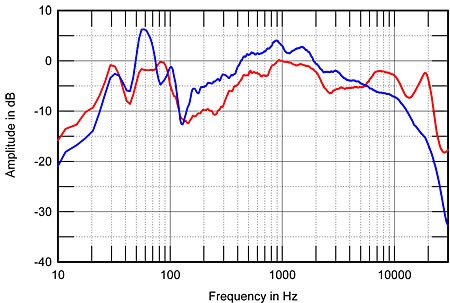
For comparison, here are the responses of two expensive commercial speakers in one particular writer’s room, with a fair bit of smoothing and spatial averaging. This was the first graph I found on Stereophile’s site. No specific criticism of the two speakers in the graph is intended. It is just a data point to illustrate traditional box speakers versus dipoles in a room.